Claude, GPT or DeepSeek? The Data Behind the Race | Peter Walker
Watch the episode on
In this episode of Tank Talks, host Matt Cohen welcomes back Peter Walker, Head of Insights at OpenRouter and formerly of Carta, where his charts on cap tables and fundraising became required reading for founders and VCs.
Peter now sits on one of the largest real-world data sets in AI, with roughly 600 trillion tokens a month flowing through a single API that gives access to 500+ models. He explains why OpenRouter is as much about routing between inference providers as between models, and why the same model can feel brilliant or terrible depending on who serves you the token.
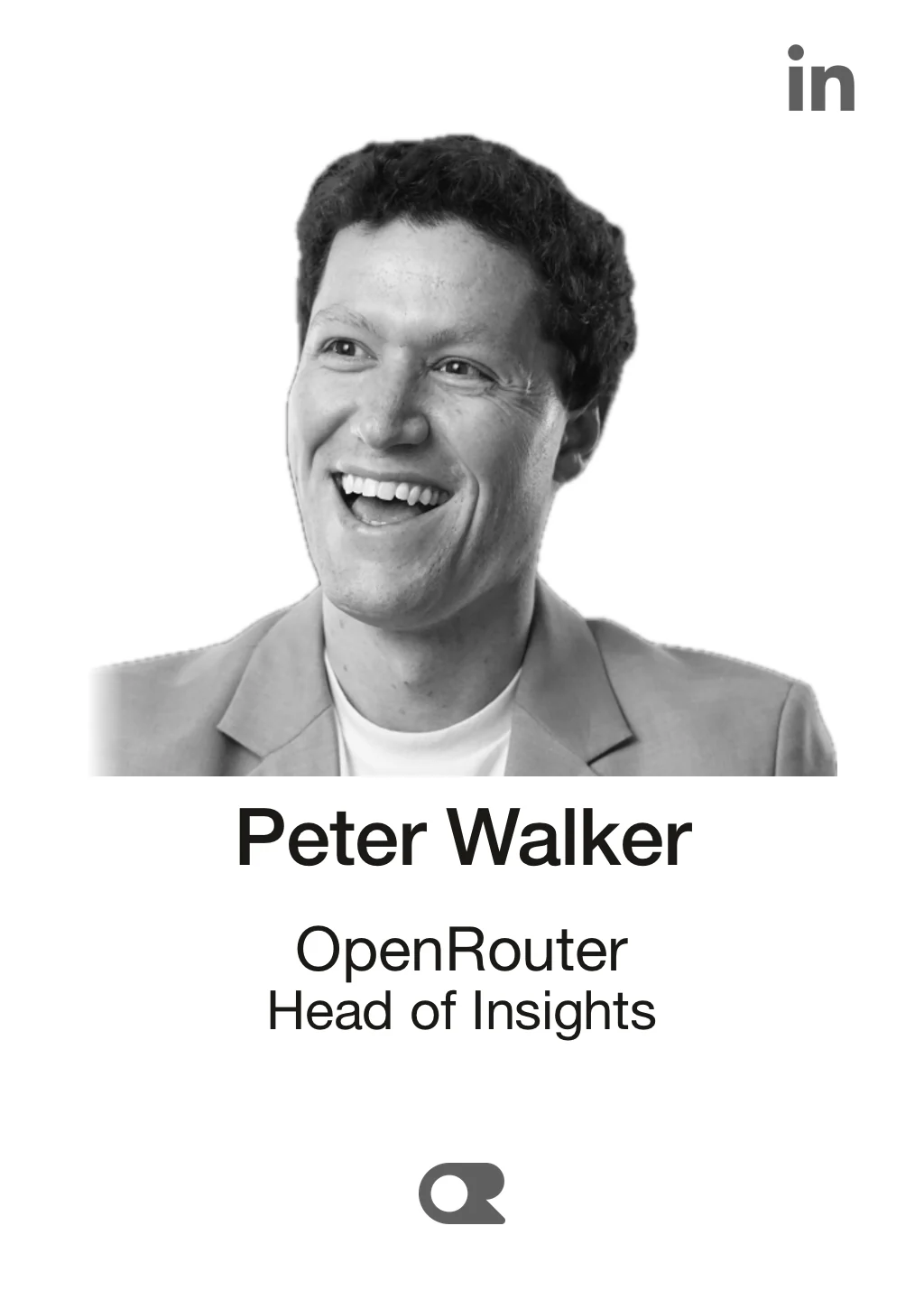
Peter Walker, Head of Insights, OpenRouter - Peter Walker is Head of Insights at OpenRouter, where he analyzes usage data across hundreds of models and inference providers.
- Previously, he spent five years at Carta turning cap table, valuation, and fundraising data into widely read charts and research.
Episode Overview
From Carta to OpenRouter
Peter’s path from a data-visualization nerd at Carta to head of insights at OpenRouter
Why he wanted to get closer to AI, and the FOMO that pulled him there
Why OpenRouter’s cross-lab view is unique: labs only see their own data, while OpenRouter sees which models, tasks, and providers are gaining traction
Joining 10 days before the Stripe acquisition was announced
What OpenRouter Actually Does
One API key for 500+ models, instead of being “a Claude shop” or “an OpenAI shop”
Why the more important layer is inference provider routing: the same open-weight model can be served by hundreds of providers with very different cost, latency, throughput, and reliability
The marketplace model: more models attract more users, which attract more providers, with a service fee on top
The founding team’s commitment to making as much data public as possible
Why Stripe and OpenRouter fit: both abstract complexity (payments and AI), and AI is now the first or second fastest-growing line item for CFOs
Fragmentation and the Agentic Turning Point
Why the market is still in early innings, from ChatGPT’s launch in late 2022 to today’s diversity of models
The shift in February 2026 from chatting with AI to agents doing the work, and why it kicked off multi-model usage
Matching models to tasks: security reviews, customer service, and why you may not need a frontier model to review your next email
Why this market, with commodity-like supply and complex demand, has no real precedent
Bad Tokens, Good Tokens
Why the inference layer is more complex than the model layer
Closed models are served by a handful of places, while open models have hundreds of providers, some excellent and some “super shady”
Speed differences of up to 20x between providers serving the same model
Why people disagree so much about the same model: often it’s the token they were served, not the model
The reputational risk of putting a slow or unreliable provider behind a customer-facing app
Subscriptions vs. API Pricing
A carnival-token analogy for how tokens work
Why $100-a-month subscriptions are still fantastic deals, and why API bills can become “eye-watering”
Why the best models are still worth it for many use cases, but not for all of them
The geopolitical layer: open-weight models skew Chinese, closed-weight models skew American
Open Weights vs. the Frontier
Why OpenRouter believes in a multiplicity of winners rather than one open-or-closed champion
New model categories nobody had envisioned weeks ago, such as fast, cheap decision models for classification
Why not everything will happen inside OpenAI or Anthropic
Is AI a Bubble?
Why this isn’t the dot-com fiber glut: everyone is compute constrained, and more GPUs would be used
How supply and demand can still get out of whack
Why there’s no world where we go back to a pre-AI economy
Reading Anthropic’s S1
The scale of the multi-year, largely non-cancellable compute commitments
Why Peter sees Anthropic as highly profitable on inference, with the open question being whether it can fulfill its commitments
14x growth last year from a base of roughly $780 million, at a company only three years old
The reported 900% net dollar retention, and why it’s remarkable even if it doesn’t repeat
Why using more Anthropic and adding open-weight models to the portfolio aren’t mutually exclusive
Neo-Clouds and the GPU Gold Rush
Where the next token gets served from when most of Anthropic’s compute is with the hyperscalers
50+ inference providers apply to join OpenRouter each week, and very few are accepted
What a neo-cloud really is: capital-intensive GPU access plus software that runs models faster and more reliably
Why it’s hard: capital markets, energy supply, infrastructure teams, 100% uptime, and deal-making skills that SaaS never needed
Neo-labs vs. neo-clouds, and why many labs will transition into clouds
Fine-Tuning, Distillation, and Model “Nerfing”
Fine-tuning: how legal AI companies turn a strong base model plus proprietary data into a specialized product
Distillation: why closed labs forbid it, why the open-weight rules are murkier, and how labs distill their own models into new variants
Why “model degradation” is a red herring: slower or less reliable tokens at the inference layer and the self-cannibalizing release cycle are more likely explanations
Models vs. Harnesses
How much product and harness matter now that raw intelligence is less differentiating for some use cases
Why Peter thinks model intelligence still matters most for the top labs, and the product is everything for application-layer companies
Personal agents as the first time many people experience powerful AI without knowing which model is behind it
The Cultural Gap in AI Adoption
Why the biggest divide is generational, including the age of the company
Why diffusion beyond San Francisco and New York will likely disappoint, because it’s a person-to-person problem, not a technological one
How doom-and-gloom messaging causes people to disengage
Why everyone now has “the smartest EA in the world” in their pocket
Grieving What You Were Great At
Peter’s own experience letting AI build the charts he spent a decade mastering
Accepting the inevitability of the change and moving your expertise to the strategic layer: asking the right questions and providing the right framing
Finding new things to do that the technology enables rather than removes